Makassar, Tuesday, January 20, 2026 —
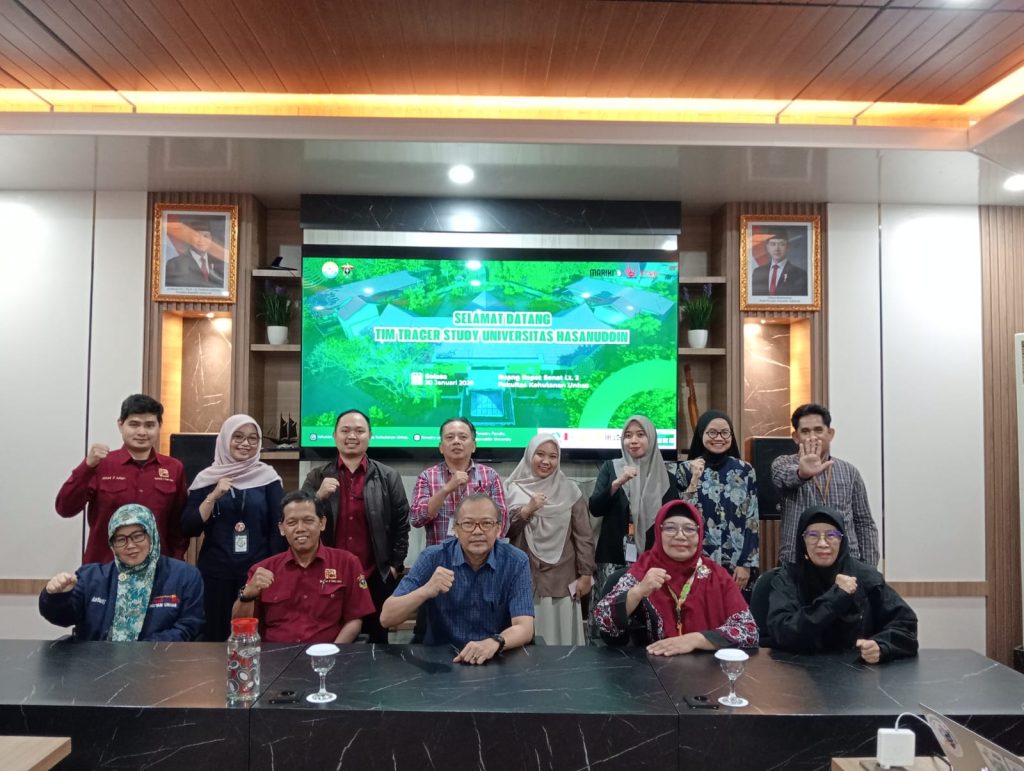
The Faculty of Forestry, Universitas Hasanuddin (Unhas), welcomed a visit from the Directorate of Alumni Relations of Universitas Hasanuddin as part of efforts to strengthen the achievement of the Main Performance Indicators (Indikator Kinerja Utama/IKU) for the 2025 Tracer Study. The meeting took place at 10:00 WITA in the Senate Room, 2nd Floor of the Faculty of Forestry, Unhas.
The activity was conducted as a follow-up to the monitoring results of IKU Tracer Study achievements at the faculty level, with a minimum target of 80 percent in accordance with DIKTISAINTEK standards. The meeting focused on discussing existing challenges and formulating strategic steps and joint follow-up plans, particularly to improve the response rate and overall achievement of the 2025 Tracer Study IKU.
The Director of Alumni Relations of Universitas Hasanuddin, Prof. Dr. Muhammad Yusuf, S.Pt., Ph.D., IPU, emphasized the importance of adopting the right approach to alumni so that the Tracer Study is understood as a form of collective contribution.
“Alumni need to see that completing the Tracer Study is a contribution to the university. This data is crucial in demonstrating the competitiveness of Unhas graduates and their acceptance across various employment sectors,” he stated.
He also highlighted the need for optimal alumni data management and the active role of Persons in Charge (PICs) in contacting alumni to ensure that data is completed thoroughly until the final stage.
“We still have time until the end of February. With the right approach, we expect the achievement of the Unhas Tracer Study to continue improving,” he added.
Meanwhile, Prof. Dr. Eng. Amiruddin, S.Si., M.Si., explained that the Tracer Study plays a strategic role for faculties, particularly in enhancing employee reputation. He stressed that the data collection process must be carried out honestly and transparently.
“PICs are expected not to manipulate data or fill in information without alumni consent. It is also important to convey to alumni that the Tracer Study is a strategic institutional necessity,” he explained. He further encouraged the evaluation of Tracer Study questionnaires to make them more efficient and less burdensome for alumni.
During the discussion session, Prof. Syahidah, S.Hut., M.Si., Ph.D., Vice Dean for Partnerships, Research, Innovation, and Alumni Affairs, outlined several challenges encountered in alumni data collection. These included low response rates and communication barriers, as some alumni were unfamiliar with the PICs and suspected fraudulent activity. Nevertheless, a persuasive approach through continuous communication—led by Prof. Ida—proved to be relatively effective by clearly explaining the importance of the Tracer Study for the faculty, particularly in understanding alumni conditions after graduation, including employment status and income range. These efforts have gradually begun to generate positive responses from alumni.
Through this visit, the Faculty of Forestry Unhas and the Directorate of Alumni Relations hope to strengthen synergy and shared commitment in improving the achievement of the 2025 IKU Tracer Study, while also reinforcing the role of alumni as strategic partners of the university with impact across various sectors.