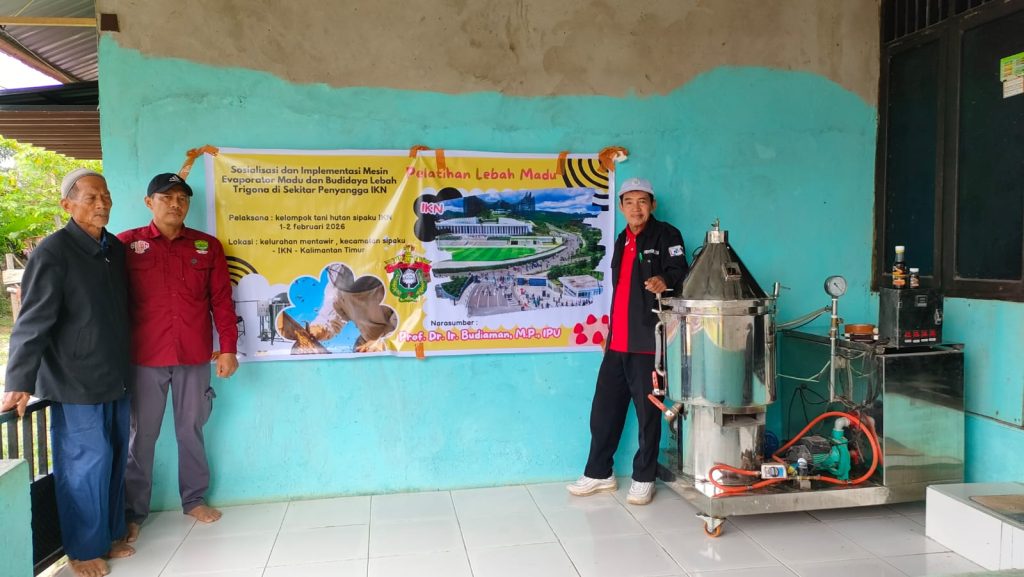
Lecturer from the Faculty of Forestry, Hasanuddin University (Unhas), actively participated as resource persons in the Socialization and Implementation of Honey Evaporator Technology and Trigona Bee Cultivation in the IKN Buffer Zone. The activity was organized by the Sipaku IKN Forest Farmer Group and held on 1–2 February 2026 in Mentawir Village, Sepaku Sub-district, Nusantara Capital City (IKN), East Kalimantan.
The program aimed to enhance the capacity of stingless bee farmers through the introduction of appropriate honey processing technology and the strengthening of Trigona bee cultivation practices adapted to the ecological conditions of the IKN buffer area. This initiative supports the development of sustainable non-timber forest products and aligns with the vision of IKN as a green and environmentally friendly city.
During the activity, participants were introduced to a stingless bee honey evaporator machine with a power capacity of 2,000 watts, an installed production capacity of 50 liters per three hours, and an operating temperature of 45 degrees Celsius. The machine operates based on the principle of water evaporation from honey, enabling the reduction of moisture content while preserving the natural aroma and quality of stingless bee honey. Participants also received direct education on honey characteristics, including tasting honey harvested directly from the nest.
In addition to honey processing technology, the program featured training and field practice on stingless bee cultivation in the IKN buffer zone, including colony multiplication techniques and identification of stingless bee species commonly found in the area, namely Heterotrigona itama and Tetragonula fuscobalteata. Practical sessions on propolis harvesting from Heterotrigona itama colonies were conducted at local farmers’ home yards, providing hands-on learning experiences.
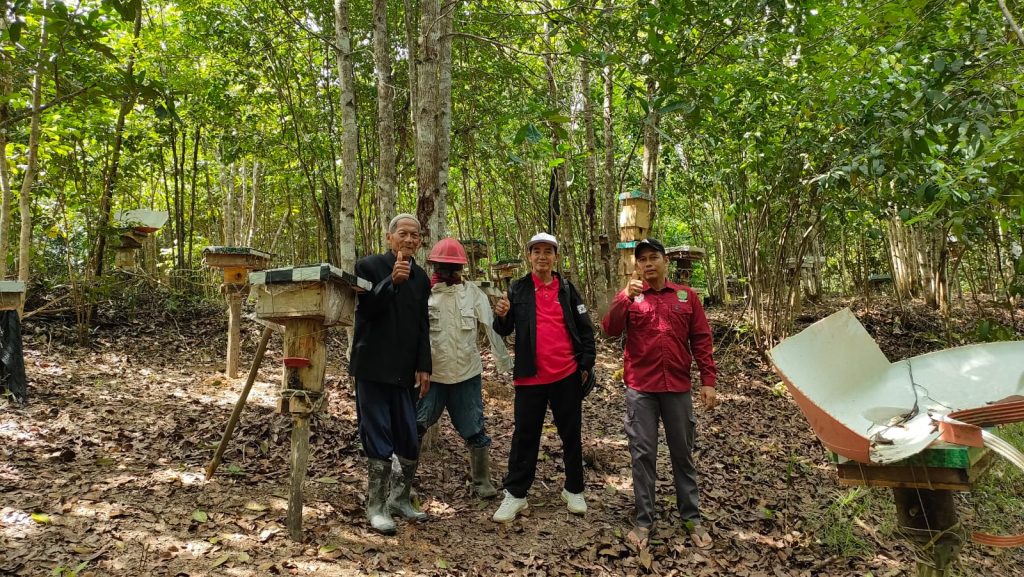
The main resource person, Prof. Dr. Ir. Budiaman, MP, IPU, a lecturer from the Faculty of Forestry, Hasanuddin University, emphasized that the activity represents the implementation of academic research to address challenges in tropical honey production in Indonesia.
“Through this program, we implement the results of honeybee research to improve the quality of stingless bee honey, particularly by reducing its high moisture content to meet the 2024 Indonesian National Standard (SNI), while also delivering tangible benefits for farmers, agroforestry practitioners, and honey-based MSMEs,” he stated.
He further explained that the Sepaku IKN area possesses high vegetation potential and floral diversity that strongly support stingless bee development. This activity also serves as a continuation of previous stingless bee training programs conducted in collaboration with the East Kalimantan Provincial Forestry Service in 2023, ensuring sustainable community empowerment around the IKN buffer zone.
The participants showed strong enthusiasm throughout the activity and expressed their interest in continued technical assistance from the Faculty of Forestry, Hasanuddin University. They expect further guidance in developing non-heat honey processing technology, quality testing, product certification, and the advancement of village-based MSMEs utilizing stingless bee products. In the long term, the program is expected to improve honey quality, create new employment opportunities, increase local income, and support sustainable development in the IKN buffer area.