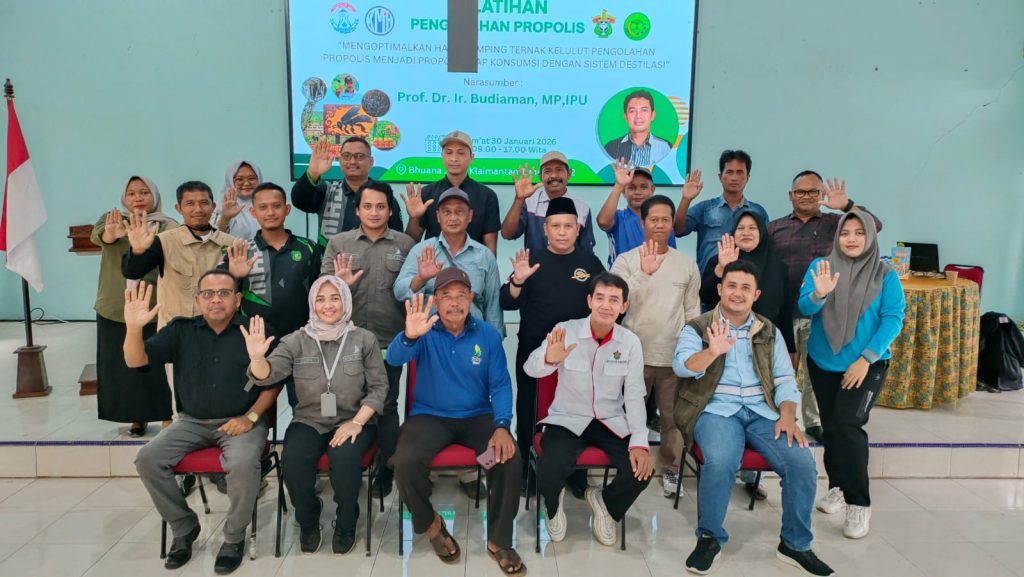
A lecturer of the Faculty of Forestry, Hasanuddin University (Unhas), Prof. Dr. Ir. Budiaman, MP, IPU, conducted a training program on stingless bee propolis processing at Bhuana Jaya Village Hall, Tenggarong Seberang District, East Kutai Regency, on Friday, January 30, 2026. The activity was part of Unhas’ commitment to implementing research outcomes that directly support community empowerment and sustainable utilization of non-timber forest products.
The training highlighted the potential of native Kalimantan stingless bee species, namely Lophotrigona canifrons and Heterotrigona itama, which are known for their high propolis productivity. In addition to theoretical sessions held at the village hall, participants also took part in hands-on practice, including direct propolis harvesting from Heterotrigona itama colonies at local farmers’ homes.
Prof. Budiaman emphasized that the program was designed to bridge academic research and real community needs. “This training aims to implement the results of our research in the field of honeybee science so that it can have a tangible impact on society. It also supports the achievement of Key Performance Indicators (IKU) and strengthens science and technology with broader social benefits, particularly for agroforestry farmers, stingless bee keepers, and honey-based MSMEs,” he explained.
He further noted that the activity was carried out in synergy with local government and coal mining companies operating in the area. This collaboration focuses on community empowerment through environmentally friendly business development, including the rehabilitation of post-mining land by planting bee-forage vegetation within a stingless bee–based agroforestry system.
According to Prof. Budiaman, East Kalimantan has exceptional ecological conditions for stingless bee development. “The region’s high diversity of vegetation and flowering plants creates an ideal habitat for stingless bees. Communities around mining areas have significant opportunities to rehabilitate post-mining land by integrating local Kalimantan stingless bees with agroforestry practices,” he stated.
The training involved multiple stakeholders, including the Government of Bhuana Jaya Village, KTH Tuah Himba, PKSM Bhuana Jaya, stingless bee farmer groups, forestry extension officers, Dharma Wanita of beekeeping families, as well as nearby coal mining companies. The Faculty of Forestry, Hasanuddin University, served as the main resource institution, providing scientific guidance and technical assistance throughout the program.
Participants received comprehensive material covering basic propolis theory, national and international quality standards, testing and certification procedures, and propolis harvesting and processing techniques. Practical sessions included the separation of honey, wax, and propolis using solar-powered extractors, multistage distillation processes, and the development of derivative products such as herbal powders, wound remedies, and eye drops made from honey and propolis.
The training received strong enthusiasm from participants, who attended the program until its completion and expressed interest in further mentoring, particularly in product testing, certification, and advanced product development. Prof. Budiaman expressed optimism that the program would generate long-term impacts, including job creation in rural areas, strengthening village-based MSMEs, empowering women through home industries, and increasing the added value of stingless bee products in a sustainable manner.