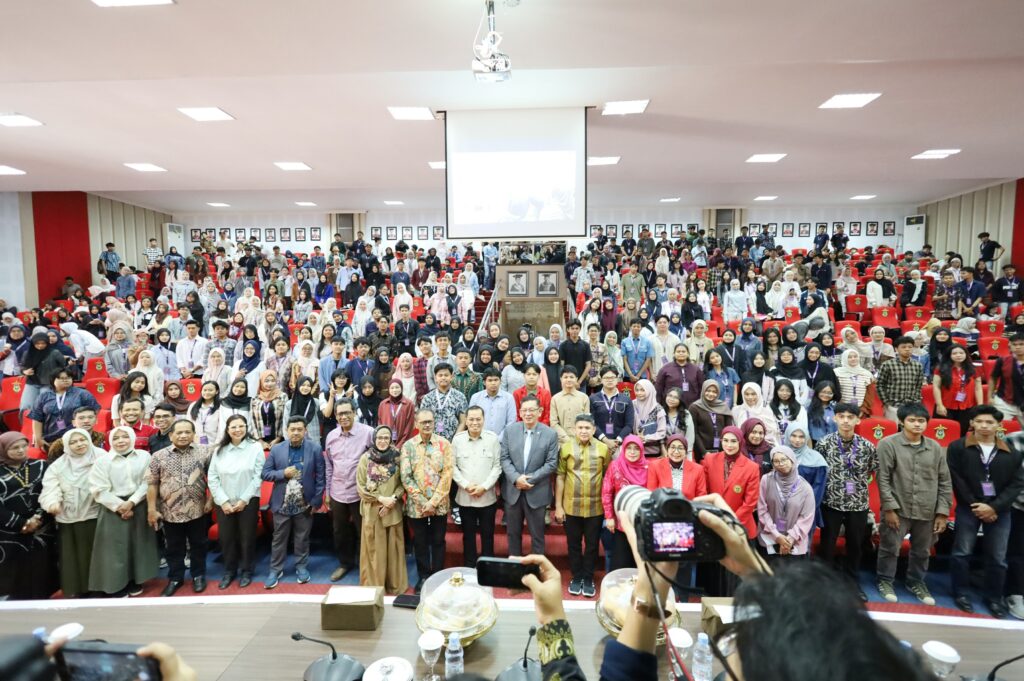
Tamalanrea-Makassar. The Forest Conservation Study Program (Prodi) of the Faculty of Forestry, Hasanuddin University (Unhas) held a Public Lecture with the theme “Genetic and Genomic Studies for Biodiversity Conservation”. The activity took place starting at 10.00 WITA in the 1st Floor Hall of the Faculty of Forestry, Unhas Tamalanrea Campus, Makassar, Friday (20/9/2024).
Starting the activities of the Deputy Dean for Academic and Student Affairs, Faculty of Forestry, Unhas, Dr. Ir. Syamsu Rijal, S.Hut., M.Sc., IPU. In his speech, he said that this activity is quite important to know because it discusses genetic and genomic studies for biodiversity conservation, which are currently not widely carried out in the Conservation Study Program.
“Thank you for the presence of Prof. Koichi Kamiya at this public lecture, I really hope that the students of the Faculty of Forestry, Unhas, can make good use of this opportunity to expand their knowledge about genetic and genomic studies for biodiversity conservation,” explained Dr. Syamsu Rijal.
On the same occasion, Head of the Forest Conservation Study Program, Faculty of Forestry, Hasanuddin University, Prof. Dr. Ir. Ngakan Putu Oka, M.Sc. In his speech, he said that research using a genetic approach had not yet been widely carried out in forest conservation study programs, so that was why Prof. Kamiya was invaluable this time.
“We are very grateful and highly appreciative to Prof. Kamiya, who in his busy schedule still managed to make time to hold a public lecture today. Students will use this opportunity well to expand their knowledge of molecular approaches in solving conservation problems especially in the Wallacea Bioregion,” explained prof. OK.
Furthermore, prof. Oka hopes that Prof. Kamiya opens the way for cooperation for the Forest Conservation study program and a bridge of opportunity for students to study at Ehime University.
Present as a resource person was Prof. Koichi Kamiya (Professor Faculty of Agriculture, Ehime University) presented material on molecular evolution and population genetics as well as the phylogeographic history of a species.
Genetic diversity is DNA differences between individuals or differences between populations. Genetic diversity includes mutation and genetic recombination and is the main source of genetic diversity.
“A single mutation will change the frequency across generations, while a neutral mutation has the characteristics of increasing or decreasing in frequency depending on population size, remaining or disappearing in a population and being shared between district populations through migration,” explained Prof. Koichi Kamiya.
Phylogeographic diversity of tropical rainforest trees. Tropical rainforests in Southeast Asia have historically been unstable, climate change in the Pleistocene has influenced patterns of population genetic variation and the biogeographic distribution of species.
After the presentation of the material, the activity then continued with a question and answer session. Activities continued smoothly until 12.00 WITA.