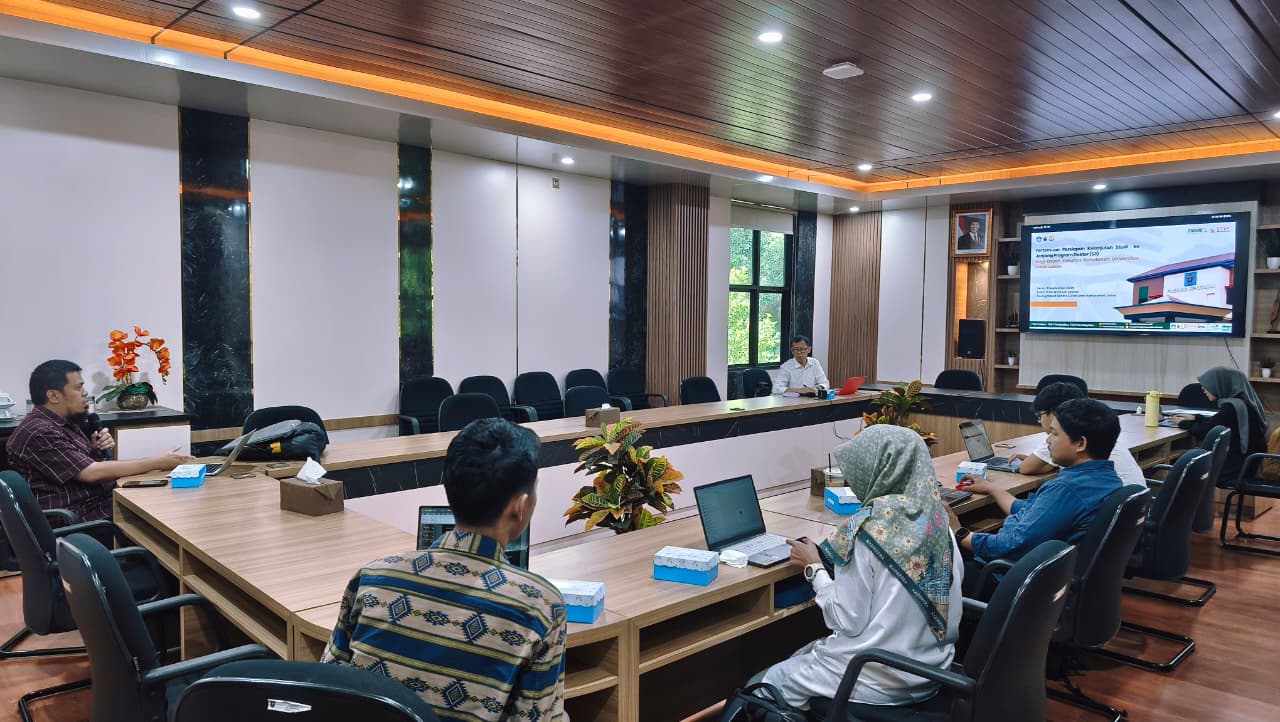
Tamalanrea-Makassar. The Faculty of Forestry, Hasanuddin University (Unhas) through the Partnership, Research and Innovation Sector held a Focus Group Discussion (FGD) on the Establishment of Collaborative Research. The activity took place starting at 09.00 WITA in the Senate Meeting Room, 2nd Floor, Faculty of Forestry, Unhas Tamalanrea Campus, Makassar, Thursday (22/8/2024).
Starting the activities of the Deputy Dean for Partnership, Research and Innovation, Faculty of Forestry, Unhas Unhas, Syahidah, S.Hut., M.Si., Ph.D. In his speech, he said that the FGD activity to establish collaborative research was one step in helping and making it easier for lecturers to improve article writing and publication.
“Thank you for the presence of resource persons at this activity in the context of sharing research on the topic of developing active food packaging based on sugar palm biomass and utilization of forestry waste as a source of biocomposite hydrogel. I hope that these two research topics can be developed by lecturers at the Unhas Forestry Engineering study program into several “more interesting research topics,” explained Syahidah.
Syahidah further said that Unhas Forestry Engineering study program lecturers who will conduct research on hydrogel and biomass biocomposites can collaborate with the biomass and bioproduct center of the National Research and Innovation Agency (BRIN) and Tomsk Polytechnic University, Russian Federation.
Present as a resource person were Prof. Dr. Widya Fatriasari, S.Hut., M.M. from the BRIN Center for Biomass and Bioproducts and Antonio Di Martino, Ph.D. from Tomsk Polytechnic University, Russian Federation.
Prof. Dr. Widya Fatriasari in his material explained about lignin-based biorefinery. Biorefinery is a complex industrial activity, converting renewable materials (biomass) into fiber, chemicals, fuel and other products with minimal or no effect on environmental sustainability.
“Biorefinery refers to the exploration of biomass to produce fuel, energy and chemicals used in life,” explained Prof. Widya.
The biorefinery industry currently still relies on the use of cellulose, while lignin, a by-product, is still considered to be of low value. Lignin is the second most abundant natural polymer that makes up plant cell walls after cellulose.
The activity went smoothly until 11.00 WITA and ended with a joint discussion session.